

Treat every AI tool used in hiring, promotion, discipline, or termination as a regulated asset and build a cross-functional compliance engine around it now. The EEOC's Title VII framework applies to automated employment decisions regardless of whether a vendor built the model. NYC Local Law 144 mandates independent bias audits to be conducted regularly. DOL and White House OSTP principles require meaningful human oversight. Five artifacts make the difference between audit-ready and exposed:
-
Tool inventory classifying each AI system by decision impact: hire, promote, discipline, terminate
-
Version-controlled policies with change logs and approval records
-
Bias audit summaries with documented test cohorts and mitigation steps
-
Vendor contracts with explicit audit rights and model-change notice clauses
-
DSAR/DSR logs capturing every data subject access request and its resolution
Building a centralized compliance engine that stores these artifacts and treats AI tools as regulated assets is the baseline expectation regulators and plaintiffs' counsel will look for first.
Key Takeaways
HR AI compliance requires treating automated employment decision tools as regulated assets, building a cross-functional governance engine, and maintaining version-controlled evidence that survives an enforcement review.
| Point | Details |
|---|---|
| Classify tools by decision impact | Tag each AI tool as high or low impact; hiring, promotion, and termination tools require the most urgent attention. |
| State laws vary significantly | NYC, Colorado, Illinois, California, and Connecticut each impose different notice, audit, and recordkeeping obligations. |
| Vendor contracts must include audit rights | Require audit rights, model-change notice, and DSAR-handling clauses before signing any high-impact HR AI contract. |
| Document your own bias testing | A "reasonable care" standard applies; vendor attestations alone do not satisfy it. Run and retain your own bias audit reports. |
| Jonathanjboone advisory services | Jonathanjboone delivers cross-functional governance workshops, tool inventories, and audit-ready evidence packages for HR and legal teams. |
Table of Contents
- What does HR AI compliance require you to do right now?
- What U.S. regulations apply to HR AI tools?
- How do you manage vendors and enforce HR AI compliance contractually?
- How do you assess and document bias risk in HR AI tools?
- How do you build a cross-functional compliance engine for HR AI?
- Why HR leaders must treat AI as enterprise risk
- Jonathanjboone advisory services for HR AI governance
- Sources
What does HR AI compliance require you to do right now?
Five steps. Each one has a quick-win deliverable you can complete in a short timeframe and a longer project deliverable for the months ahead.
Step 1: Build a living tool inventory
Owner: HR with IT support.
Pull every AI or algorithmic tool touching an employment decision: applicant tracking systems with scoring features, video interview analysis platforms, performance management tools with predictive ratings, scheduling algorithms, and compensation benchmarking engines. For each tool, record the vendor name, version identifier, data inputs, outputs, and one critical tag: does the output substantially assist or replace human decision-making? That classification drives which laws apply and how frequently you must test.
Quick win: a spreadsheet with tool name, vendor, version, decision type, and impact classification. Longer project: a formal AI asset register integrated into your vendor management system with regular refresh cadence.
Step 2: Risk-classify each tool
Owner: Legal with HR input.
Not every AI tool carries the same exposure. A scheduling optimizer that fills open shifts carries far less enforcement risk than a resume-screening model that filters candidates before a human ever sees them. Classify tools on two axes: decision impact (high = hire/fire/promote/discipline; low = scheduling/benefits lookup) and likelihood of disparate impact (based on the demographic sensitivity of the input data). High-impact, high-likelihood tools go to the front of your remediation queue.
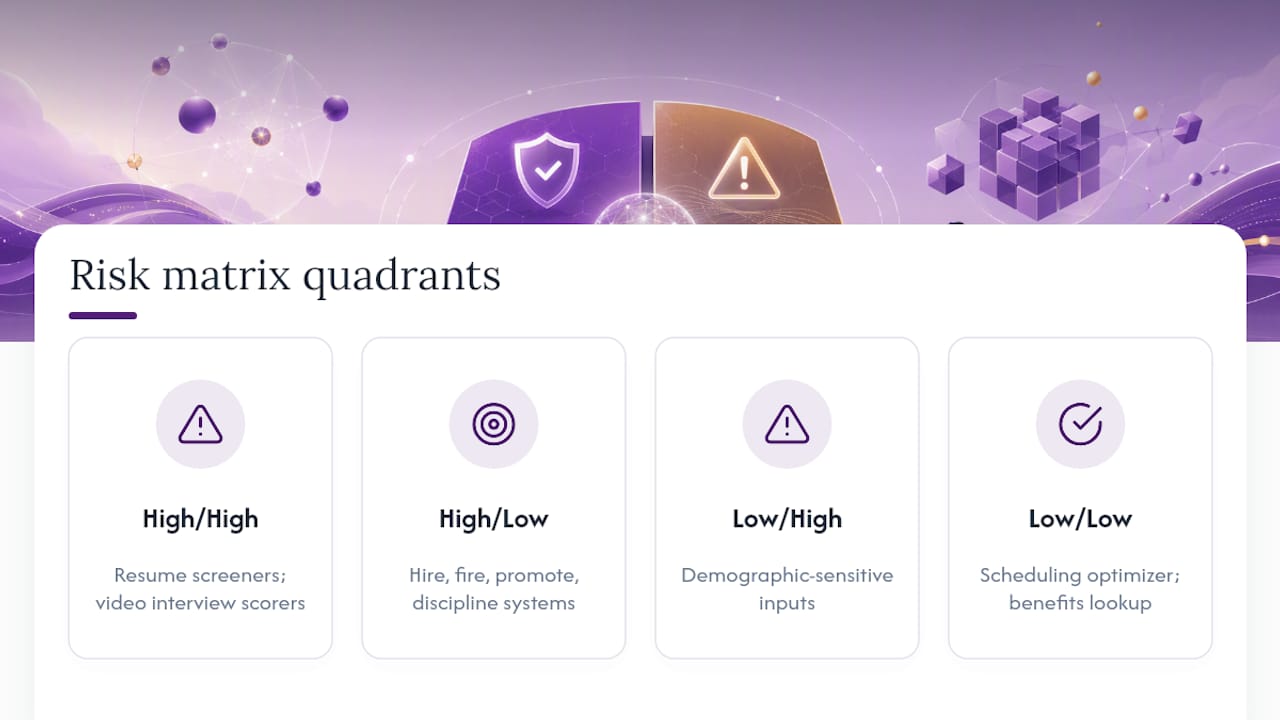
Quick win: a two-by-two risk matrix with each tool plotted. Longer project (2–4 months): a formal AI risk assessment for each high-impact tool, documented and signed off by Legal.
Pro Tip: Start with hiring and termination tools. Enforcement actions and litigation concentrate there. A resume screener or video interview scorer used in NYC, Illinois, or Colorado triggers specific statutory obligations — get those under control before touching lower-risk tools.
Step 3: Establish vendor governance
Owner: Legal and Procurement.
Every vendor contract for a high-impact AI tool needs four things before you sign: audit rights (your right to commission or receive an independent bias audit), a model-change notice clause (vendor must notify you before material updates), a data processing addendum covering retention and portability, and clear DSAR-handling responsibilities. IAPP practitioners flag vendor management as the most commonly neglected control — and the one that creates the most exposure when enforcement arrives.
Quick win: a vendor contract checklist used at every new procurement. Longer project: re-negotiate existing contracts for high-impact tools to insert missing protections.
Step 4: Run bias testing and document results
Owner: HR Analytics or an independent third party, with Legal oversight.

For high-impact tools, run disparate impact analysis at least annually. Measure selection ratios by race, sex, and national origin. Track false positive and false negative rates across demographic groups. Document the test cohort, methodology, results, and any mitigation steps taken. K&L Gates counsel advises that employers must apply a "reasonable care" standard and cannot rely on vendor attestations alone — your own documented testing is what reduces enforcement exposure.
Quick win: a bias testing protocol document approved by Legal. Longer project: first completed bias audit report for each high-impact tool, with results shared with the executive team.
Step 5: Build governance and training infrastructure
Owner: HR, Legal, and IT jointly.
Assign a named AI steward responsible for the tool inventory and audit schedule. Train HR staff on what AI tools do, what their limitations are, and when to override an automated output. Document that training with sign-off logs. Establish an incident response procedure for complaints alleging AI-driven discrimination. A 90-day sprint gets the governance skeleton in place; a six-month program embeds it into standard operating procedure.

Quick win: a named AI steward and a one-page incident response procedure. Longer project: a full training curriculum with completion tracking and an annual governance review cycle.
What U.S. regulations apply to HR AI tools?
The regulatory picture is a patchwork, and it is moving fast. SHRM's 2026 analysis confirms that employers now face meaningfully different obligations depending on where they hire and operate.
Federal anchors apply everywhere:
- EEOC / Title VII: Automated tools that produce disparate impact on a protected class violate federal anti-discrimination law. The employer is liable, not just the vendor.
- DOL AI Principles: Stress worker transparency, meaningful human oversight, and the right to contest automated decisions.
- White House OSTP AI Bill of Rights: Non-binding but sets the expectation for notice, explanation, and human fallback options that regulators reference in enforcement guidance.
State and local rules vary by jurisdiction. The table below maps the most consequential ones.
Colorado and Connecticut recently enacted or amended employer AI governance obligations, and Illinois extended its Human Rights Act anti-discrimination standard explicitly to AI-driven employment decisions.
Jurisdiction-specific actions:
- Hiring in NYC: commission an annual independent bias audit, publish the summary, and provide advance written notice to candidates before using an automated employment decision tool.
- Operating in Illinois: provide notice to candidates and employees when AI is used in an employment decision and maintain records of that notice.
- Operating in Colorado: implement a documented risk management program and provide notice to individuals subject to AI-driven decisions.
- Operating in California: honor DSAR requests for automated decision logic, minimize data collected, and document the legal basis for each AI use.
A practical design principle: build your baseline program to satisfy the strictest applicable standard, then layer jurisdiction-specific notice and audit requirements on top. That approach, recommended across multiple global HR AI frameworks, is more cost-effective than running parallel programs.
How do you manage vendors and enforce HR AI compliance contractually?
Vendor contracts are where most employers leave themselves exposed. The tool may be the vendor's, but the liability for a discriminatory outcome is yours.
Contract checklist for every high-impact HR AI tool:
- Audit rights: Your right to commission or receive an independent bias audit of the model, including access to aggregate test data.
- Model-change notice: Vendor must notify you in writing before any material change to the model, algorithm, or training data, with a defined notice period (30 days minimum).
- Data processing addendum: Covers data retention periods, deletion obligations, portability for audit purposes, and sub-processor disclosure.
- DSAR handling: Clear allocation of who responds to data subject access requests and within what timeframe.
- Indemnity and liability allocation: Vendor indemnifies you for claims arising from defects in the model's design; you retain responsibility for deployment decisions.
- Version identifiers: Vendor provides and maintains version identifiers for every model update, so your change log stays accurate.
Red flags in vendor responses:
- Opaque model descriptions ("proprietary algorithm" with no further detail)
- Refusal to grant audit rights or to share bias testing methodology
- No documented bias testing history
- Vendor-only indemnity clauses that shift all deployment liability to you without reciprocal protections
- No model-change notification process
Pro Tip: Require legal review at the RFP stage, not after procurement. Once a contract is signed, inserting audit rights and bias-testing obligations is difficult and sometimes impossible. IAPP practitioners consistently flag late legal involvement as the single most common vendor governance failure.
How do you assess and document bias risk in HR AI tools?
A defensible bias assessment follows a repeatable flow. Here is the practical sequence.
Risk assessment flow:
- Classify the tool's decision impact (high/medium/low) using the matrix from Step 2.
- Identify data inputs: what demographic proxies might the model use directly or indirectly (zip code, graduation year, name)?
- Select test cohorts: define the demographic groups you will analyze, aligned with EEOC protected classes.
- Run bias tests: calculate selection ratios, apply the 4/5ths rule, and measure false positive and false negative rates across groups.
- Record results and mitigations: document what you found, what you changed, and when.
Metrics to track and when to escalate:
| Metric | What It Measures | When to Surface to Legal |
|---|---|---|
| Selection ratio by group | Whether protected groups advance at lower rates | Any group below 80% of highest-selected group |
| False positive rate | Model incorrectly advances unqualified candidates | Significant disparity across groups |
| False negative rate | Model incorrectly filters out qualified candidates | Any protected group filtered at higher rate |
| Confidence interval width | Statistical reliability of results | Narrow sample sizes requiring caution |
Artifacts to retain:
- Bias audit reports (retain for at least three years, longer if litigation is pending)
- Version identifiers and change logs for every model update
- Job posting artifacts showing the criteria the model was trained against
- DSAR logs with request date, response date, and resolution
NYC Local Law 144 requires that the bias audit summary be published and that candidates receive advance notice. Retaining the underlying audit report, not just the published summary, is what protects you in a complaint-driven enforcement review.
Sample internal audit report outline:
- Executive summary and scope
- Tool description and version identifier
- Test cohort definition and data sources
- Methodology (statistical tests applied)
- Results by demographic group
- Identified disparities and root-cause analysis
- Mitigation steps taken and timeline
- Residual risk assessment
- Sign-off by Legal and HR leadership
How do you build a cross-functional compliance engine for HR AI?
Treating AI governance as a siloed HR project is the primary failure mode. Experian's cross-functional compliance model requires HR, Legal, IT/Security, Payroll, and Operations to share defined responsibilities.
Role responsibilities:
- AI Steward (HR): Owns the tool inventory, coordinates bias audits, tracks regulatory changes, and reports to the executive team quarterly.
- Legal Reviewer: Reviews vendor contracts, signs off on bias audit methodology, advises on jurisdiction-specific obligations, and manages incident response.
- IT/Security Custodian: Maintains version identifiers, manages data processing addenda, controls access to AI systems, and supports DSAR fulfillment.
- HR Operational Owner: Runs day-to-day use of each tool, documents human-in-the-loop decisions, and flags anomalies to the AI Steward.
- Payroll/Compensation Reviewer: Audits AI-driven compensation recommendations for disparate impact before implementation.
Operational cadence:
- Quarterly: Refresh the tool inventory; review regulatory tracker for new state laws; test DSAR workflow end-to-end.
- Annually: Commission bias audits for all high-impact tools; re-certify vendors; update training curriculum; executive compliance report.
- At every model update: Log the version change; assess whether the update triggers a new bias test; notify Legal if the change is material.
Pro Tip: Win executive buy-in by framing AI governance as enterprise risk management, not an HR project. Present the tool inventory and bias audit schedule to the C-suite the same way you would present a cybersecurity risk register. Boards understand liability; connect AI compliance to that language.
Pro Tip: Embed ethics review into procurement. Before any new HR AI tool reaches the contract stage, require a one-page ethics and bias pre-screening completed by HR and Legal jointly. This prevents high-risk tools from entering the environment before governance controls exist.
Governance artifacts to maintain:
- Policy library with version control and approval history
- Evidence repository: bias audit reports, training logs, vendor certifications
- Incident response runbook with defined escalation paths
- Executive reporting template updated quarterly
Why HR leaders must treat AI as enterprise risk
The compliance frameworks covered here are not administrative overhead. They are the architecture of organizational accountability. HR leaders who treat AI governance as a legal checkbox miss the larger point: every automated decision that affects an employee's livelihood is a leadership decision, whether a human signed off on it or not.
The most consequential gap in most organizations is not a missing policy document. It is the absence of a named person who owns the question "Is this tool producing fair outcomes?" That accountability gap is what regulators and plaintiffs' counsel look for first. A cross-functional governance model with a named AI steward, documented bias testing, and version-controlled evidence closes that gap in a way that no vendor attestation can.
The 90-day roadmap in this article is not the end state. It is the foundation. Organizations that complete it will have the inventory, the tested tools, the vendor protections, and the governance cadence to respond to a regulatory inquiry or an employee complaint without scrambling. That readiness is itself a form of organizational integrity.
A concrete next step: convene a 90-minute cross-functional risk-mapping workshop with HR, Legal, IT, and one business leader. The output is a completed tool inventory with impact classifications and a prioritized remediation list. That single session produces more compliance progress than months of policy drafting without it.
Jonathanjboone advisory services for HR AI governance
Jonathanjboone works directly with HR executives, legal teams, and higher education institutions that need to move from awareness to audit-readiness without building a compliance program from scratch.
Engagements typically include a facilitated cross-functional risk-mapping workshop, a completed tool inventory with impact classifications, vendor contract review against the checklist above, a bias audit framework tailored to your tool set, and an executive briefing package. Most clients have a 90-day remediation plan and a governance operating model within the first engagement cycle.
This is not a generic training program. It is structured advisory work that produces the specific artifacts regulators and legal counsel will ask for: the inventory, the audit reports, the vendor protections, and the governance cadence. If your organization uses AI in hiring, promotion, or performance management and does not yet have those artifacts in place, Jonathanjboone to discuss where to start.
Sources
Quarterly monitoring of these primary sources keeps your compliance program current as state laws and federal guidance evolve.
- AI, Employee Data & Paid Leave: Building a Cross‑Functional Compliance Engine for 2026 - Employer Services Insights
- Navigating the AI Employment Landscape in 2026 — K&L Gates
- Companies work to navigate operational, legal challenges associated with AI in HR systems — IAPP
- New Year Brings New AI Regulations for HR — SHRM
- Title VII of the Civil Rights Act of 1964 — EEOC
Review this list quarterly. When a new state law passes or a federal agency issues updated guidance, pull the primary text first, then check SHRM and IAPP for practitioner interpretation. Use the regulatory texts for policy language and audit justification; use the practitioner trackers for horizon scanning and governance reporting to your executive team.
This article provides general information for educational purposes and does not constitute legal advice. Confirm current obligations with qualified legal counsel and the relevant regulatory authority for your jurisdiction.
This article is general information, not a substitute for advice from a qualified lawyer. Consult a qualified legal professional about your own circumstances before acting on anything here.