

Boards must treat AI oversight as a core fiduciary responsibility: assign clear accountability, require an AI inventory and risk register, and demand regular, risk-tiered reporting and independent assurance. This is not optional. AI changes your organization's risk profile and its value-creation potential simultaneously, which makes governance a board-level obligation, not a management courtesy.
Request these from management at your next meeting:
- A complete AI system inventory, including third-party and embedded tools
- A risk register with each system classified by risk tier (high, medium, low)
- A summary of AI-related incidents or near-misses in the past 12 months
- Results of any third-party vendor assessments or internal audit reviews
- Current policy documents governing AI procurement, deployment, and decommissioning
- A disclosure readiness memo addressing SEC material risk reporting obligations
Immediate board actions to authorize this quarter:
- Assign AI oversight responsibility to a named committee or the full board, and document it in the charter
- Commission an AI readiness assessment if one has not been completed in the past 18 months
- Set a reporting cadence: quarterly AI risk summaries to the board, with escalation triggers defined in writing
- Require management to present a vendor risk management protocol for all AI suppliers
- Schedule a board-level AI literacy session before the next governance cycle
Key Takeaways
Effective board oversight of AI requires assigning clear accountability, maintaining a risk-tiered AI inventory, setting a defined reporting cadence, and commissioning independent assurance for high-risk systems.
| Point | Details |
|---|---|
| Assign governance ownership | Name a committee or full board as responsible for AI oversight and document it in the charter. |
| Require an AI inventory and risk register | Every AI system in production needs a risk tier, named owner, and documented controls. |
| Set escalation triggers in writing | Severity 1 incidents require board notification within 24–48 hours; define thresholds before an incident occurs. |
| Demand independent assurance annually | Internal audit scope and external third-party reviews should be defined in committee charters for high-risk systems. |
| Jonathanjboone advisory services | Board workshops, readiness assessments, and advisory engagements help governance leaders build and implement AI oversight frameworks. |
Table of Contents
- Why AI oversight belongs at the board level
- What governance model fits your board?
- What should boards review and how to evaluate it?
- What reporting and assurance should boards expect?
- What U.S. regulatory context should boards watch?
- How to embed AI oversight into ERM, procurement, and the SDLC
- How should boards handle AI incidents and decommissioning?
- How should boards resource AI oversight?
- A realistic implementation timeline for boards
- What boards often get wrong about AI governance
- Jonathanjboone's advisory services for boards navigating AI governance
- Sources
Why AI oversight belongs at the board level
AI is not a technology project. It is a source of enterprise risk and strategic opportunity that touches every function, from hiring and lending decisions to supply chain and customer service. That scope makes board oversight of AI a fiduciary matter, not a delegation to the CTO.
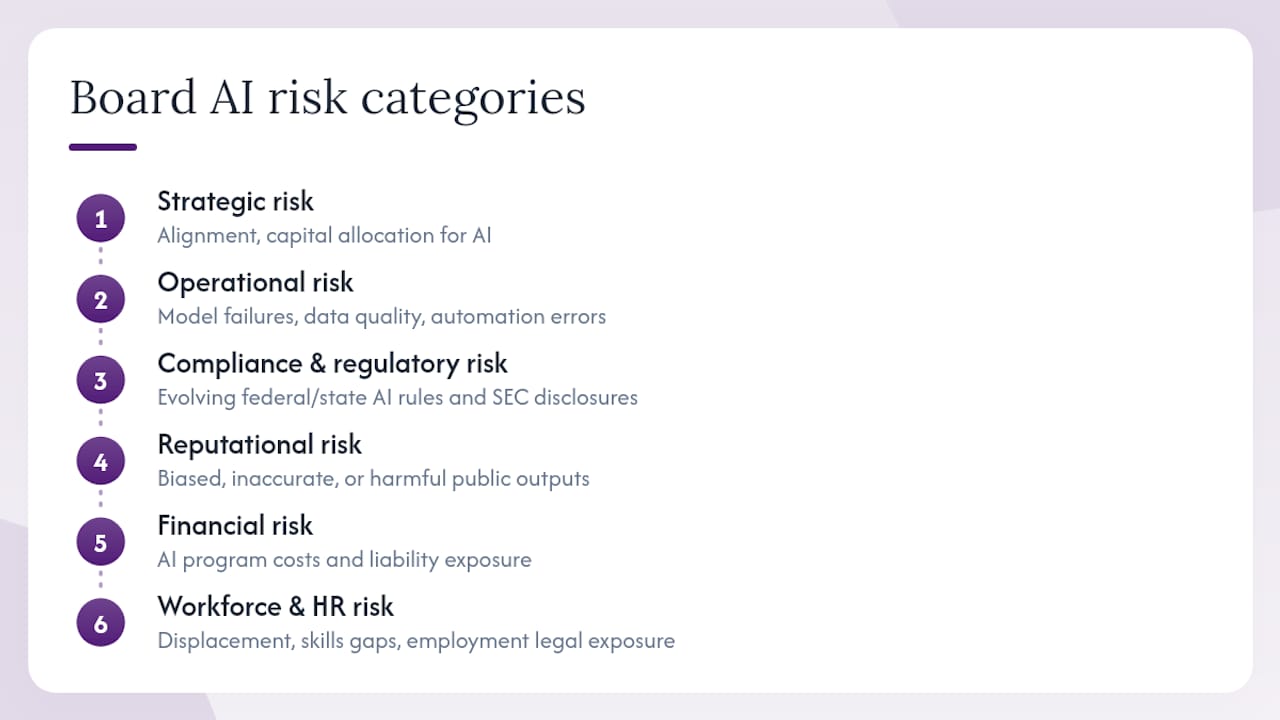
The risk categories boards must track fall into six areas. Strategic risk covers whether AI investments align with organizational goals and whether the board has approved a capital allocation framework for AI. Operational risk includes model failures, data quality problems, and automation errors that disrupt services. Compliance and regulatory risk involves evolving federal and state AI rules, SEC disclosure obligations, and sector-specific requirements in finance, healthcare, and education. Reputational risk arises when AI systems produce biased, inaccurate, or harmful outputs that become public. Financial risk covers both the cost of AI programs and the liability exposure from AI-driven decisions. Workforce and HR risk includes displacement, skills gaps, and the legal exposure that comes from using AI in employment decisions.
Corporate governance reporting shows that board-level AI oversight remains uneven. Surveys tracked by Harvard Law School's corporate governance forum indicate a minority of boards have formally embedded AI oversight in committee charters or approved dedicated annual AI budgets. Shareholders and institutional investors are now asking directly. The AI Index 2025 Report from Stanford HAI documents the pace of AI adoption across sectors, giving boards concrete benchmarking data to justify investment decisions and reporting cadence.
What governance model fits your board?
Three patterns dominate current practice. Each has real tradeoffs.
Full-board oversight with standing reporting works for smaller boards or organizations where AI is central to the business model. Every director receives AI risk summaries at each meeting. The advantage is collective accountability. The risk is that without structured preparation, discussions stay surface-level.
A dedicated technology or AI committee handles deep-dive reviews, vendor assessments, and policy recommendations before escalating to the full board. This model concentrates expertise and reduces meeting time pressure. The NACD Director Essentials on implementing AI governance recommends integrating AI oversight responsibilities explicitly into committee charters, covering AI strategy, capital allocation, AI risk, and technology competency. Audit committees are increasingly expanding their remit to include AI-related risk and assurance, per guidance from Harvard Law School's corporate governance forum.
A hybrid model assigns detailed review to a committee while requiring the full board to receive a summary report at least twice a year and to vote on high-stakes AI decisions above defined thresholds. This is the most common pattern in large organizations and the one most governance advisors currently recommend.
Committee charters and full-board responsibility statements must explicitly include:
- Scope of AI systems covered (first-party, third-party, embedded)
- Escalation triggers that require full-board notification (e.g., a high-risk system failure, a regulatory inquiry, a material incident)
- Decision thresholds: which AI deployments require board approval vs. management sign-off
- Reporting frequency and format
- Responsibility for monitoring regulatory change (SEC, federal agencies, state law)
- Annual review of the AI governance framework itself
Delegation boundaries matter. The full board should retain authority over AI systems that affect material financial disclosures, employment at scale, or safety-critical operations. Everything below that threshold can be delegated to a committee or management, with defined reporting back.
Academic research on responsible AI governance, including the Responsible AI Pattern Catalogue published in ACM Computing Surveys, identifies independent oversight bodies and ethics committees as recognized governance patterns at the organizational level. These are not theoretical. They are operational structures boards can adopt.
Pro Tip: Never let AI literacy sit with one director. If your board's AI knowledge is concentrated in a single "tech director," you have a single point of failure. Every director needs a baseline. Schedule a structured AI briefing annually, and rotate the responsibility for presenting AI updates so the knowledge spreads.
What should boards review and how to evaluate it?
Board oversight of AI requires translating fiduciary duties into specific evidence requests. The OECD Due Diligence Guidance for Responsible AI recommends assigning board responsibility for AI due diligence, maintaining inventories and records, and establishing incident monitoring and decommissioning processes. That guidance maps directly to the following board responsibilities.
Oversight responsibilities by fiduciary duty:
- Strategy and capital allocation: Review and approve the AI investment strategy. Confirm AI spending aligns with organizational priorities and that ROI metrics are defined before deployment.
- Risk oversight: Require a risk register with each AI system classified by tier. High-risk systems (those affecting employment, credit, safety, or public-facing decisions) need documented controls and independent review.
- Policy and ethical standards: Confirm written policies exist for data use, bias testing, human-in-the-loop requirements, and prohibited use cases.
- Talent and competency: Assess whether management has the internal expertise to govern AI, and whether training programs exist for staff who operate AI systems.
- Vendor and third-party controls: Require a vendor risk protocol covering contract clauses, transparency obligations, audit rights, and change-control procedures.
- Incident response and decommissioning: Confirm escalation paths exist and that decommissioning procedures are documented for systems that are retired or replaced.
| Board question | Evidence to request | Assurance or follow-up |
|---|---|---|
| What AI systems does the organization operate? | Complete AI inventory with system name, owner, purpose, data inputs, and risk tier | Verify inventory was independently validated, not self-reported only |
| How are high-risk systems controlled? | Risk register entries with documented controls, testing results, and human oversight mechanisms | Request internal audit confirmation that controls are operating |
| Have any AI incidents occurred? | Incident log with dates, system involved, impact, and remediation steps | Ask whether any incidents were reportable under SEC or sector rules |
| Are vendors contractually accountable? | Vendor contracts with audit rights, SLA terms, transparency clauses, and change-control provisions | Confirm legal counsel reviewed AI-specific contract language |
| Is the board's AI governance framework current? | Annual review memo from management or committee | Require a gap analysis against NACD or OECD frameworks |
A complete AI inventory lists every system in production, including third-party APIs and embedded tools in HR, finance, and operations. Red flags: an inventory that covers only internally built tools, lacks risk tier classifications, or has not been updated in more than six months.
What reporting and assurance should boards expect?
Boards need two reporting layers: a board-level summary and a deeper audit committee review. Neither replaces the other.
Recommended KPIs for board-level reporting:
- Number of AI systems in production, by risk tier
- Percentage of high-risk systems with documented controls and completed testing
- AI incident count, severity distribution, and average time to remediate
- Vendor risk scores for material AI suppliers
- Fairness and accuracy drift indicators for high-risk models (flagged when thresholds are breached)
- Compliance status against applicable regulatory requirements
- Percentage of directors who have completed AI literacy training
The OECD AI Governance Playbook recommends integrated cross-functional governance with explicit checkpoints and decision paths for approval and escalation. That structure should be reflected in the dashboard the board receives: not a raw data dump, but a tiered summary with clear escalation flags.
Reporting cadence:
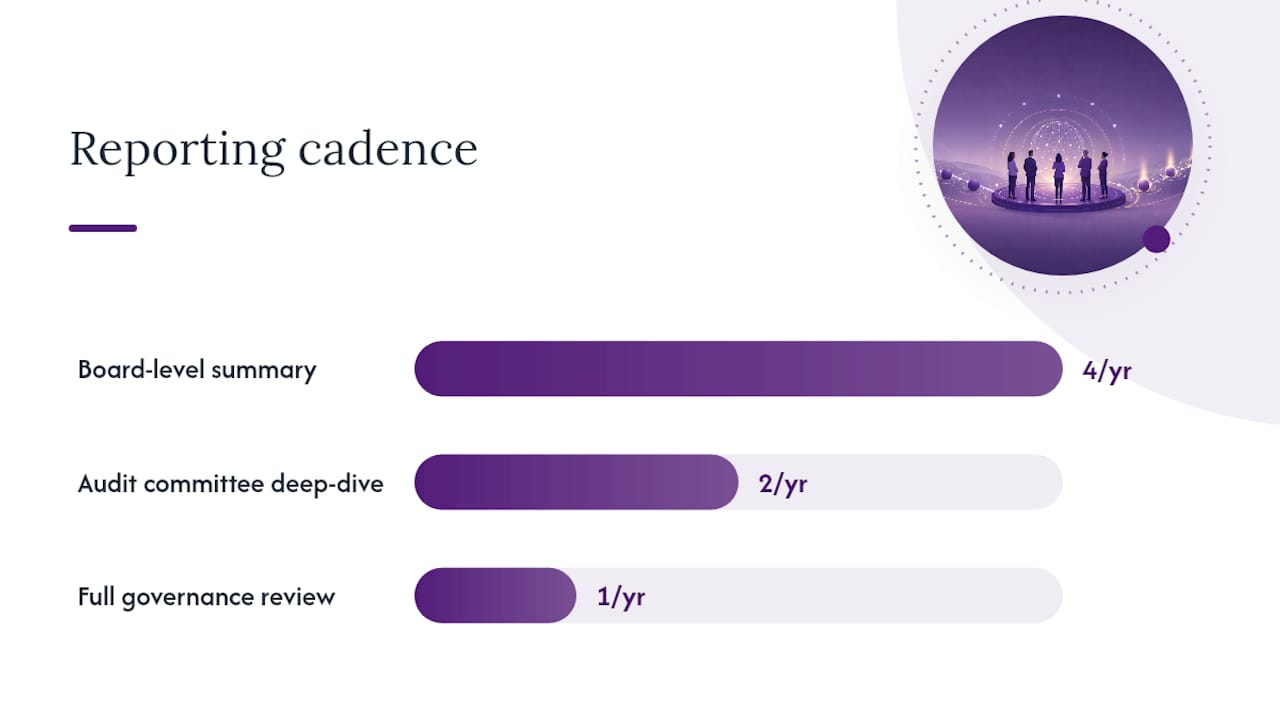
- Quarterly: Board-level AI risk summary (1–2 pages), incident log, KPI dashboard
- Semi-annual: Audit committee deep-dive on high-risk systems, vendor risk review, policy compliance status
- Annual: Full AI governance framework review, external assessment results, regulatory change summary
When to require independent assurance:
Independent assurance is necessary when AI systems have material business or safety impacts. Internal audit should include AI risk in its annual scope. External third-party assessments are appropriate for high-risk systems, before major AI deployments, and when regulatory scrutiny is elevated. Harvard Law School's corporate governance forum guidance on audit committees recommends that audit committees define the scope and frequency of AI-related reviews in their charters.
| KPI | Risk tier | Escalation threshold |
|---|---|---|
| High-risk systems without documented controls | High | Any system above zero triggers immediate committee review |
| AI incident severity | High / Medium | Severity 1 incidents escalate to full board within 48 hours |
| Fairness/accuracy drift | High | Breach of pre-set threshold triggers remediation review |
| Vendor risk score | Medium / High | Any supplier rated high-risk requires board notification |
| Time to remediate incidents | All tiers | Average delay triggers process audit |
What U.S. regulatory context should boards watch?
The SEC is the primary U.S. regulator boards must monitor for AI-related disclosure and enforcement expectations. The SEC's existing rules on material risk disclosure apply to AI: if an AI system failure, bias incident, or regulatory action could be material to investors, it must be disclosed. Boards that have not assessed AI materiality are exposed to enforcement risk, not just reputational risk.
Federal agency guidance on AI is evolving across multiple departments, including the FTC, EEOC, CFPB, and sector regulators in banking and healthcare. State-level AI legislation is accelerating, with several states now requiring algorithmic impact assessments for employment and lending decisions. Boards should require management to maintain a regulatory monitoring function and report changes to the board at least semi-annually.
Surveys tracked by Harvard Law School indicate that shareholder attention to AI governance is rising sharply, with institutional investors asking boards directly about oversight structures and disclosure practices.
Practical disclosure actions boards should require from management:
- A materiality assessment covering all high-risk AI systems
- A review of existing risk factor disclosures to confirm AI risks are accurately described
- A vendor risk disclosure protocol for material third-party AI dependencies
- A process for monitoring and escalating regulatory changes to the board
The OECD Due Diligence Guidance for Responsible AI provides internationally recognized principles that U.S. boards can use to benchmark their governance against global standards, particularly relevant for organizations with international operations or investors.
How to embed AI oversight into ERM, procurement, and the SDLC
Governance that lives only in board meetings does not govern anything. Boards should require management to embed AI controls into three operational processes: enterprise risk management, procurement, and the software development lifecycle.
-
Enterprise risk management integration. AI risks belong in the ERM framework alongside cyber, financial, and operational risks. Require management to include AI risk categories in the annual ERM assessment and to map AI risks to existing risk appetite statements. High-risk AI systems should appear on the enterprise risk register with named owners.
-
Procurement checkpoints. Before any AI vendor contract is signed, boards should require that management has completed a vendor due diligence checklist. That checklist must cover: transparency about training data and model architecture, contractual audit rights, SLA terms for accuracy and uptime, change-control procedures that require notification before model updates, and data residency and security standards. The OECD AI Governance Playbook recommends explicit checkpoints and decision paths at each stage of the AI lifecycle, including procurement.
-
SDLC checkpoints. For internally developed AI systems, governance checkpoints should be embedded at design, testing, deployment, and monitoring stages. Industry guidance from Databricks stresses defined ownership, risk classification, and operational checkpoints embedded in the SDLC as the foundation of effective AI governance. Boards should require management to produce model card summaries for high-risk systems: a one-page document covering intended use, known limitations, testing results, and human oversight mechanisms.
-
Escalation and approval thresholds. Translate risk tiers into deployment decisions. High-risk systems require board or committee approval before deployment. Medium-risk systems require documented management sign-off and a post-deployment review within 90 days. Low-risk systems can be deployed under standard procurement controls with annual review.
-
Documentation artifacts boards can request. Model card summaries, data provenance logs, vendor attestations, red-team test results, and bias audit reports. These are the evidence base for board oversight. If management cannot produce them, that is itself a finding.
How should boards handle AI incidents and decommissioning?
Boards need a clear picture of what happens when an AI system fails, produces harmful outputs, or is flagged by a regulator. The escalation path should be defined before an incident occurs.
Expected escalation flow:
- Severity 1 (material harm, regulatory trigger, or public exposure): Management notifies the board chair and committee chair within 24–48 hours. Full board notification within 5 business days. External counsel engaged immediately.
- Severity 2 (significant operational failure or bias finding): Committee notified within 5 business days. Remediation plan presented at next scheduled committee meeting.
- Severity 3 (minor failure, contained impact): Logged in incident register. Reported in quarterly board summary.
Decommissioning checklist boards should require:
- Written decommissioning plan with rationale, timeline, and data disposition
- Confirmation that replacement system (if any) has completed risk classification and approval
- Audit of any decisions made by the decommissioned system that may require review or remediation
- Notification to affected stakeholders where required by contract or regulation
How should boards resource AI oversight?
Director training is not optional. Every director needs a working understanding of AI fundamentals before they can ask useful questions of management.
Training topics every director should cover:
- AI fundamentals: how machine learning models work, what training data is, and what model outputs mean
- Model risk: accuracy, drift, hallucination, and the limits of AI reliability
- Bias and fairness: how bias enters AI systems, how it is tested, and what remediation looks like
- Data governance: data quality, provenance, privacy, and retention
- Vendor risk: how to evaluate third-party AI suppliers and what contractual protections matter
- Legal and regulatory basics: SEC disclosure obligations, EEOC guidance on AI in employment, state AI laws
When to engage external experts:
External advisors are appropriate when the board lacks internal expertise for a specific assessment, when a high-risk system requires independent review, or when a regulatory inquiry requires specialized legal analysis. Firms like WilmerHale provide legal analysis on AI governance and regulatory exposure that boards can use to evaluate their disclosure posture and governance structures. EY and similar advisory firms offer AI governance assessments that benchmark board oversight effectiveness against current standards.
Selection criteria for external reviewers:
- Independence from the AI systems being reviewed
- Relevant domain experience (not just general technology consulting)
- Demonstrated familiarity with applicable regulatory frameworks (SEC, EEOC, sector regulators)
- Clear scope of work with defined deliverables and timelines
Budget framing: External AI governance assessments typically range from a focused gap analysis to a full governance audit. Boards should require management to budget for at least one external review per year for high-risk AI programs, and to include AI governance advisory costs in the annual operating budget. The cost of a governance failure, including regulatory fines, litigation, and reputational damage, far exceeds the cost of prevention.
A realistic implementation timeline for boards
Governance frameworks do not materialize overnight. A 90/180/365-day structure gives boards a realistic sequence.
90 days:
- Assign AI oversight to a named committee or the full board; update the charter
- Commission an AI inventory and risk register from management
- Complete a board-level AI literacy session
- Define escalation triggers and reporting cadence in writing
180 days:
- Review the completed AI inventory and risk register; challenge gaps
- Require management to present vendor risk protocols for all material AI suppliers
- Commission an external AI governance gap assessment
- Confirm AI risks are reflected in ERM and in SEC risk factor disclosures
365 days:
- Receive results of the external assessment and approve a remediation roadmap
- Embed AI governance checkpoints in procurement and SDLC processes
- Complete the first annual AI governance framework review
- Set performance expectations for management that include AI governance metrics
The NACD Director Essentials framework links AI oversight directly to fiduciary duties and notes that many boards have not yet assessed AI disruption or approved annual AI budgets. That gap is the starting point for most boards in 2026.
Pro Tip: Chairs and CEOs who want AI governance to stick should tie it to performance reviews and capital allocation decisions. If AI governance metrics appear in the CEO's annual objectives and in the criteria for approving AI investments, the organization treats governance as real. If they do not, governance stays on paper.
What boards often get wrong about AI governance
The conventional wisdom says boards need more AI expertise. That is partly true, but it misses the more common failure: boards that have the expertise but have not translated it into governance structures, evidence requirements, and escalation paths.
A board with one technically sophisticated director and four directors who defer to them has not solved the governance problem. It has created a dependency. Governance requires the full board to ask informed questions, challenge management evidence, and make decisions. That requires baseline literacy across all directors, not depth in one.
The second common failure is treating AI governance as a compliance exercise. Boards that check the box on an AI policy without requiring evidence that the policy is operating, tested, and enforced are not governing. They are documenting. The difference shows up when something goes wrong: a board with real governance has an incident log, a remediation record, and an escalation trail. A board with paper governance has a policy document and no evidence it was ever used.
The third failure is underestimating vendor risk. Most organizations use more third-party AI than they build internally. Boards that focus oversight on internal AI development while leaving vendor AI unreviewed have a blind spot in the most likely place for a governance failure.
Jonathanjboone's advisory services for boards navigating AI governance
Boards that want to move from principles to practice need structured support, not another framework document. Jonathanjboone delivers board workshops, tailored advisory engagements, and AI governance readiness assessments designed specifically for governance leaders who need to translate oversight obligations into board-level decisions, charter language, and reporting expectations.

A typical engagement begins with a governance readiness assessment: a structured review of current board structures, committee charters, AI inventory status, and disclosure posture. From there, Jonathanjboone works with the board and senior leadership to build the evidence requirements, escalation paths, and reporting cadence the board needs to govern AI with confidence. Workshops are designed for directors, not technologists. Every session produces a concrete output: a charter amendment, a board question set, a reporting template, or a vendor risk checklist.
For boards that need independent assurance facilitation, Jonathanjboone coordinates the scope, selection, and review of external assessments, so the board receives findings it can act on rather than a report it cannot evaluate. Visit Jonathanjboone to schedule a governance readiness conversation.
Sources
- OECD Due Diligence Guidance for Responsible AI (EN)
- Director Essentials: Implementing AI Governance
- SEC
- Oecd
- AI Index 2025 Report (HAI Stanford)
This article is general information, not a substitute for advice from a qualified lawyer. Consult a qualified legal professional about your own circumstances before acting on anything here.